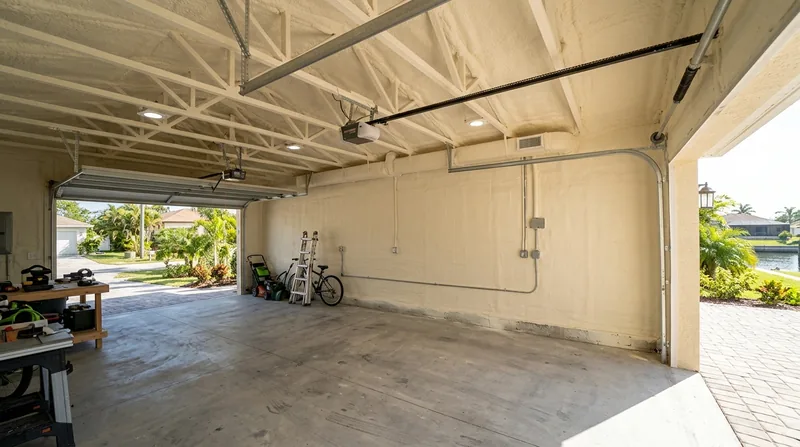




Cape Coral's housing stock is built almost entirely on slab foundations with vented attics that bake through long, hot summers. Most homes are single-story concrete block structures dating back to the 1950s and onward, clustered along the canal system and spread across neighborhoods from Cape Harbour down to Pelican and up toward Burnt Store. In this climate zone 2A environment, where humidity sits in the air nearly year-round and vapor pressure pushes from outside toward the air-conditioned interior, garages represent a weak point that many homeowners overlook. When a garage sits against conditioned living space with no thermal break between them, hot, humid air presses through the shared wall and ceiling, raising cooling costs and driving moisture into cavities where it has nowhere to go. Garage spray foam insulation in Cape Coral seals those boundaries, cuts heat gain, and stops the moisture that the region's long summers deliver. We foam garage ceilings and shared walls to protect the conditioned space beyond and bring the cooling load back into balance.
Why Garage Spray Foam Insulation Matters in Cape Coral's Hot, Humid Climate
A typical Cape Coral garage sits uninsulated and unconditioned, with a metal or tile roof that absorbs heat all day. The ceiling above it is often a simple drywall soffit with no air sealing, and the wall shared with the kitchen or hallway is just block and drywall with a hollow cavity between. During the day, that garage heats to 110 to 120 degrees Fahrenheit, and at night, when the air conditioning inside is running hard, humid air from outside leaks through gaps and cracks into the walls and ceiling cavities. Over weeks and months, that moisture accumulates where you cannot see it. Spray foam stops both the air leakage and the heat transfer at once, and because it expands to fill voids completely, it seals the cavity so moisture cannot enter in the first place.
- Blocks heat transfer through the garage ceiling and shared wall, lowering the cooling load on your air handler.
- Seals air leaks that let humid outside air penetrate into wall and ceiling cavities.
- Prevents moisture accumulation in cavities where it would promote mold and weaken the structure over time.
- Creates a conditioned or semi-conditioned space that is safer for tools, vehicles, and stored items.
A well-sealed garage also reduces the strain on your HVAC system and can lower your monthly cooling bill by eliminating one of the biggest uncontrolled heat sources in the home.
Key info: Most Cape Coral homes built before 1990 have no insulation in the garage ceiling or shared walls. If your garage is hotter than the outside air in summer, or if you smell humidity or mustiness in the garage, air and moisture are leaking in. A spray foam inspection will identify exactly where the leaks are and what it costs to seal them.
For more on how spray foam protects against moisture in our climate, see our crawl space spray foam insulation page, which addresses the same moisture challenge in a different part of the home.
How We Spray Foam Your Garage Ceiling and Shared Walls in Cape Coral
The process starts with a site assessment. We identify the garage ceiling height, the construction of the shared wall, any existing vents or electrical runs, and the condition of the substrate (the surface we will spray onto). If the substrate is wet, contaminated, or leaking, we walk away and recommend fixing the moisture source first. Once we confirm the space is dry and ready, we set up mechanical ventilation to move fumes out of the home during the spray and cure period. We then spray the foam in controlled passes, building to the thickness and R-value required by your local building code and specified in your estimate.
- We inspect the garage and shared wall for moisture, leaks, and substrate condition before any work begins.
- We install mechanical ventilation to control odor and fumes during spray and cure.
- We spray foam in multiple passes to the specified thickness, maintaining the manufacturer's drum temperature and mix ratio.
- We allow a re-entry window of 24 to 48 hours before you occupy the space again.
- We provide a written estimate showing the R-value, thickness, and square footage of foam applied.
The entire job typically takes one day for a standard two-car garage, though cure time means you should plan to keep the door closed and the space unoccupied for at least 24 hours afterward.
Local example: A Cape Harbour garage with a 12-foot ceiling and a shared wall against the kitchen was losing cool air and building humidity. We foamed the ceiling to R-38 and the shared wall to R-21, using closed-cell foam for its moisture resistance. The homeowner noticed the garage stayed cooler and the kitchen stayed drier within a week, and the cooling bill dropped by about 8 percent.
For more detail on the spray foam process and the differences between foam types, see our page on closed-cell spray foam insulation, which is the standard choice for garages in humid climates.
| Approach | Description | Best for |
|---|---|---|
| Closed-cell spray foam on garage ceiling | High-density foam that expands minimally and hardens quickly, providing R-6 to R-7 per inch and acting as an air and vapor barrier. | Garage ceilings in humid climates where moisture resistance and durability are priorities. |
| Closed-cell spray foam on shared walls | Same product applied to the wall cavity between garage and conditioned space, sealing air leaks and blocking heat transfer. | Walls shared between garage and kitchen, hallway, or bedroom where air sealing is critical. |
| Open-cell spray foam (budget alternative) | Lower-density foam that expands more and cures softer, providing R-3.5 per inch and better sound dampening but less moisture resistance. | Garage ceilings where cost is the priority and the space is not subject to standing water or chronic dampness. |
| Partial foam plus air sealing | Spray foam applied to the shared wall only, with the garage ceiling left unfoamed but sealed with caulk and tape to stop air leakage. | Budgets where the shared wall is the primary heat and moisture pathway, and the garage ceiling is vented to the attic. |
Garage Spray Foam Insulation Cost in Cape Coral: What to Expect
A garage spray foam project in Cape Coral typically starts at $1,200 for a standard two-car garage with a foam ceiling and minor air sealing on the shared wall. The final cost depends on the size of the garage, the height of the ceiling, whether you are foaming the ceiling only or both ceiling and walls, the type of foam (closed-cell or open-cell), and the R-value required by your local building code. A larger three-car garage or a garage with a higher ceiling and more wall area will cost more. Access and substrate condition also matter: if we have to move stored items, set up extra ventilation, or repair moisture damage before foaming, the cost will increase.
The best way to know what your garage will cost is to request a free estimate. We will visit the site, measure the space, assess the substrate, and provide a written quote with the R-value, thickness, and square footage. You can then compare our estimate to others and make an informed choice. For a detailed breakdown of pricing across all our services, see our full pricing page.
Garage Spray Foam Insulation Near Me: What Cape Coral Homeowners Should Know When Hiring a Contractor
Not all spray foam contractors are equal. Some operate as rig-and-run crews, spraying a job in an afternoon and leaving town before the smell fades or a problem shows up. Others are national franchises with little local accountability. The best choice is a local contractor with a local address, local plates, and a reputation in Cape Coral that matters to them personally. When you are evaluating contractors, ask for the following.
- Request a written estimate that includes the R-value, foam thickness in inches, and total square footage to be sprayed.
- Ask whether the contractor will use mechanical ventilation during spray and cure, and what the re-entry window is (24 to 48 hours is standard).
- Verify that the contractor is fully insured and ask to see a certificate of insurance naming your address.
- Ask about the warranty on workmanship and what it covers, and understand that manufacturer warranties vary by product and partner.
- Check whether your local building department requires a permit for garage spray foam, and confirm that the contractor will help you navigate what applies at your address.
- Get references from at least two previous jobs in Cape Coral and call them to ask whether the work held up and whether the contractor was professional and responsive.
If a contractor offers a price far below market with no inspection, promises immediate re-entry, or cannot provide insurance verification, walk away. The honest position, which is also the strongest selling point of a good contractor, is correct installation from the start. We are fully insured and have been in business since 2015, serving Cape Coral and the surrounding counties. If you have questions about our credentials or process, call us at (239) 360-6374 or contact us online for a free, no-obligation estimate.
Garage Spray Foam Insulation in Cape Coral: Pricing Guide
| Service | Price | Details |
|---|---|---|
| Garage ceiling foam (two-car garage) | Starting at $1,200 | Closed-cell foam to R-38 or R-40, standard 8 to 10 foot ceiling, includes mechanical ventilation and 24-hour cure window |
| Garage ceiling plus shared wall | Starting at $1,800 | Foam ceiling and adjoining wall between garage and conditioned space, typical two-car garage with 12 foot ceiling and 80 linear feet of wall |
| Three-car garage or larger | Starting at $2,200 | Increased square footage and ceiling height, plus any additional walls or vaulted ceilings that require more material and labor |
| Partial air sealing (shared wall only) | Starting at $600 | Foam applied to shared wall cavity only, without ceiling foam, for homeowners prioritizing budget and addressing the primary heat pathway |
| Travel and setup | Included | No separate mileage or travel fee within Cape Coral and surrounding service areas |
| Free estimate | No charge | Written quote with R-value, thickness, and square footage provided within 24 hours, no obligation to book |
Indicative pricing, the exact cost depends on square footage, finish, and site access. Free personalized estimate within 24h at (239) 360-6374.


