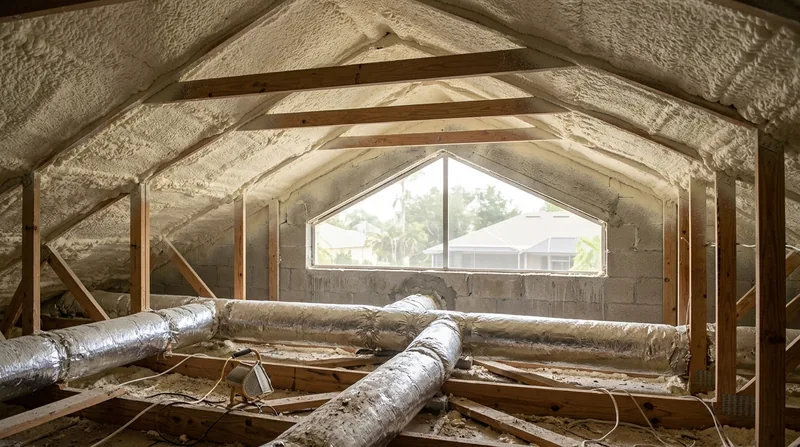




Attic spray foam insulation in Cape Coral is the most effective way to seal the vented attics that sit above nearly every concrete block home in this area. Cape Coral's housing stock, built largely from the late 1950s onward along hundreds of miles of canals off the Caloosahatchee River, depends on cooling to survive long, hot, humid summers. Most homes sit on slab foundations with ductwork and air handlers in vented attics that pull damp canal air inside through leaks and gaps. Spray foam seals those leaks, stops the stack effect that drives humid outside air into wall and ceiling cavities, and cuts the cooling load that runs your AC year-round. We spray closed cell foam suited to this hot, cooling-dominated climate zone (IECC 2A), and we pair it with proper air sealing to protect your ductwork and condition the air your home actually needs.
Why Attic Spray Foam Insulation Matters in Cape Coral's Hot, Humid Climate
Cape Coral sits in a hot, humid subtropical climate where vapor drives from the outside air toward the air-conditioned interior almost every day of the year. Vented attics in this environment are a liability, not an asset. Humid air from the canals and surrounding wetlands leaks through gaps around ductwork, light fixtures, and rim joists, cooling your attic and forcing your AC to work harder. Fiberglass batts and blown-in insulation do not stop air movement, and they absorb moisture that degrades their R-value over time. Closed cell spray foam seals the air leakage first, then insulates, and resists moisture absorption in a way that fiberglass cannot match.
- Spray foam creates an air barrier that stops humid outside air from entering wall and ceiling cavities.
- Closed cell foam resists moisture absorption and does not degrade in damp conditions.
- Sealed attics reduce the stack effect that pulls damp canal air into your home.
- Proper air sealing around ductwork and air handlers cuts the cooling load your system must handle.
- A sealed attic protects your ductwork from temperature swings that waste conditioned air.
The result is a more comfortable home, lower cooling bills, and protection against the moisture damage that plagues poorly sealed attics in this region.
Key info: Cape Coral homes built on canal-front property in the Yacht Club district, Cape Harbour, and Burnt Store are especially vulnerable to humidity infiltration. Older single-story block homes with vented attics are the most common target for attic spray foam work, and newer construction in North Cape Coral often benefits from sealed attics from the start.
For more on how closed cell foam handles this climate, see our guide to closed cell spray foam insulation in Cape Coral.
How We Seal and Insulate Your Cape Coral Attic: Step by Step
Attic spray foam starts with a thorough walk-through to identify air leaks, assess existing insulation, and plan the scope of work. We inspect ductwork, air handlers, rim joists, and the attic floor for gaps, cracks, and penetrations. We then remove any failed or contaminated insulation if needed, seal the major air leaks with foam, and apply closed cell spray foam to the attic floor or sealed roof deck. The entire process is done under controlled conditions with mechanical ventilation during cure, and we follow a twenty-four to forty-eight hour re-entry window before the space is fully occupied.
- We walk the attic to locate air leaks around ductwork, light fixtures, rim joists, and penetrations.
- We remove any failed or wet insulation and prepare the substrate for foam application.
- We seal major gaps and leaks with foam before applying the full insulation layer.
- We apply closed cell spray foam at the specified R-value and thickness per your building code and climate zone.
- We ventilate the attic mechanically during cure and provide a clear re-entry timeline.
- We inspect the finished work and provide written documentation of R-value and thickness.
The work takes one to two days depending on attic size and the extent of air sealing required, and your home is safe to occupy after the cure window closes.
Example: A typical 1,500 square foot Cape Coral ranch home with a vented attic and existing fiberglass batts requires removal of the old insulation, sealing of ductwork and rim joists with closed cell foam, and application of closed cell spray foam to the attic floor at R-38 to R-49 (3.5 to 4 inches). The job takes one to two days, and the home is ready for normal use within two days after application.
For details on how we handle insulation removal and preparation, visit our insulation removal page.
Attic Insulation Methods: Spray Foam vs. Open Cell vs. Blown-In
| Approach | Description | Best for |
|---|---|---|
| Closed Cell Spray Foam | High-density foam applied at 1.5 to 2 lbs/cubic foot, achieving R-6 to R-7 per inch. Resists moisture, provides air barrier, and stops vapor drive. | Cape Coral's hot, humid climate; sealing ductwork and air handlers; moisture control in vented attics over slab homes. |
| Open Cell Spray Foam | Low-density foam applied at 0.4 to 0.5 lbs/cubic foot, achieving R-3.5 to R-4 per inch. Allows vapor transmission and is less expensive than closed cell. | Attics where moisture control is less critical; sound dampening in garage ceilings; secondary insulation over existing batts when budget is tight. |
| Blown-In Cellulose or Fiberglass | Loose-fill insulation installed over existing batts or into cavities. Does not create air barrier. Lower cost per R-value but absorbs moisture in humid climates. | Top-up of existing sound attics where air sealing is not required; budget-conscious retrofit when foam is not feasible. |
| Fiberglass Batts (Existing) | Factory-cut batts, typically R-19 or R-38, installed between joists. Provides insulation only; does not stop air leakage or resist moisture. | Baseline in most older Cape Coral homes. Degradation and moisture absorption are common; removal and replacement with foam is the preferred retrofit. |
For most Cape Coral attics, closed cell spray foam is the best choice because it addresses both insulation and air sealing in one application, and it resists the moisture that degrades fiberglass and cellulose in this climate.
Attic Spray Foam Insulation Cost in Cape Coral: What to Expect
Attic spray foam insulation in Cape Coral typically starts at $1.50 per square foot for closed cell foam applied at standard thickness and R-value. The final price depends on several factors: the total square footage of the attic floor, the depth of insulation required by your building code (usually R-38 to R-49 in this climate zone), the condition of existing insulation and whether removal is needed, access to the attic space, and the complexity of air sealing around ductwork and rim joists. A typical 1,500 square foot attic with removal and full closed cell foam application ranges from $2,250 to $4,500 depending on these variables.
We always provide a written estimate with the R-value and thickness specified, so you know exactly what you are paying for. We recommend getting 2 to 3 estimates from qualified contractors to compare scope, materials, and warranty terms. The cheapest estimate is often the warning sign of incomplete scope or poor installation practices, not a bargain.
For a detailed breakdown of pricing by service type and to see how size and complexity affect cost, visit our full pricing page.
Attic Spray Foam Insulation Near Me: What Cape Coral Homeowners Should Know When Hiring
Hiring the right spray foam contractor is as important as the material itself. The spray foam industry includes local independents, national franchises, and transient crews that spray a job in an afternoon and disappear when the smell lingers or the foam is too thin. Before you hire, verify that any contractor carries full insurance coverage, ask for references from recent jobs in Cape Coral, and check that they understand the local building code and permitting requirements for your address. Attic ventilation, ignition barriers, and thermal barriers are governed by the energy and building code in force at your location, not by the contractor, so confirm that your contractor will coordinate with the local building department if a permit is required.
- Ask any contractor to provide a written estimate that specifies R-value, foam thickness in inches, and the total square footage being insulated.
- Verify that the contractor carries full insurance and can provide a certificate of insurance before work begins.
- Request references from at least two recent attic spray foam jobs in Cape Coral, and call them to ask about the quality of work and the contractor's responsiveness after the job.
- Confirm that the contractor will provide mechanical ventilation during cure and a clear re-entry timeline, not immediate occupancy.
- Ask whether your local building department requires a permit for attic spray foam work at your address, and whether the contractor will help you navigate the permitting process.
- Review the contractor's warranty terms in writing, including the duration of workmanship coverage and any manufacturer system warranties that apply to the foam product.
A local contractor with a track record in Cape Coral, Fort Myers, and surrounding areas, fully insured and responsive to calls, is your safest choice.
Ready to get started? Contact us for a free, no-obligation estimate at (239) 360-6374. We will walk your attic, assess the scope, and provide a detailed written quote within 24 hours.
Attic Spray Foam Insulation in Cape Coral: Pricing Guide
| Service | Price | Details |
|---|---|---|
| Closed Cell Spray Foam (attic floor) | Starting at $1.50/sq ft | Full air barrier and insulation; R-6 to R-7 per inch; includes removal of failed existing insulation and sealing of major air leaks around ductwork |
| Open Cell Spray Foam (attic or garage ceiling) | Starting at $0.90/sq ft | Lower cost alternative; R-3.5 to R-4 per inch; best for secondary insulation or sound dampening when moisture control is not critical |
| Air Sealing Only (rim joists, ductwork penetrations, light fixtures) | Starting at $500 | Foam applied to major air leaks without full attic coverage; reduces stack effect and humidity infiltration; often combined with blown-in top-up |
| Insulation Removal and Disposal | Starting at $0.50/sq ft | Removal of failed fiberglass, cellulose, or old foam; proper disposal and substrate preparation before new insulation application |
| Full Attic Retrofit (removal, sealing, and closed cell foam) | On estimate | Complete scope includes removal of existing insulation, air sealing of ductwork and rim joists, and closed cell foam to code-required R-value; requires on-site assessment |
| Free Estimate and Inspection | No charge | Walk-through of your attic, assessment of existing insulation and air leaks, written estimate with R-value and thickness, response within 24 hours at (239) 360-6374 |
Indicative pricing, the exact cost depends on square footage, finish, and site access. Free personalized estimate within 24h at (239) 360-6374.


