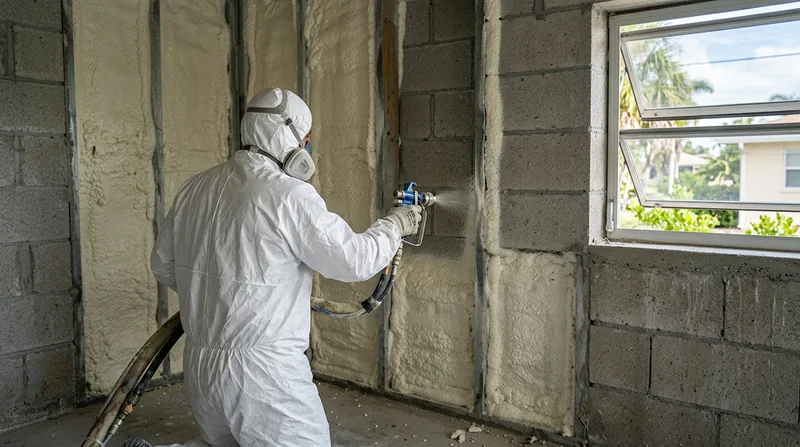




Closed cell spray foam insulation in Cape Coral is built for the moisture battle. Your home sits on a slab in one of Florida's most humid microclimates, with canal air pushing vapor into block walls, rim joists, and garage ceilings year-round. Closed cell foam stops that vapor drive cold, adds structural rigidity to wind-tested rim joists and lanai walls, and holds its R-value through decades of Gulf heat and humidity. Whether you are sealing a vented attic, protecting a garage from moisture intrusion, or bracing a rim joist against storm wind load, closed cell delivers the vapor barrier and the strength that Cape Coral's concrete construction demands. We have been doing this work since 2015, and we know exactly where moisture fails in this town.
Why Closed Cell Spray Foam Matters in Cape Coral's Humid Block Homes
Cape Coral's housing stock is almost entirely single-story concrete block on slab, built from the late 1950s onward. That slab sits on canal-adjacent soil that stays damp nearly year-round. Your air conditioning runs constantly to fight the Gulf humidity, and that temperature and humidity difference creates a vapor drive: humid outside air wants to move into the cooler, drier inside. Fiberglass and cellulose are permeable. Closed cell foam is not. It acts as a vapor retarder, stopping that moisture before it enters the wall cavity or attic insulation where it condenses, rots framing, and ruins fiberglass R-value.
- Closed cell foam resists the vapor push that dominates Cape Coral's cooling season, from May through October and beyond.
- It adds structural rigidity to rim joists and garage walls, critical where hurricane-force wind tests the envelope.
- Once cured, it holds its R-value through heat and humidity that breaks down fiberglass and cellulose over time.
- It seals air leaks in a single pass, eliminating the gaps that turn attics and garages into conditioned spaces by accident.
The payoff is a cooler, drier home and a structure that holds up to the moisture and wind that make Cape Coral tough on traditional insulation.
Key info: Closed cell foam is denser and more moisture-resistant than open cell, making it the right choice for rim joists, garages, and lanai-side rooms where humid air and storm wind pressure create the highest risk of moisture intrusion and structural damage in Cape Coral homes.
For details on permitting and thermal barrier requirements in Cape Coral, consult the City of Cape Coral Development Services, which administers the building code for your address.
How We Install Closed Cell Spray Foam in Cape Coral Attics, Walls, and Rim Joists
Closed cell foam goes down in thin, controlled passes. We measure the substrate, set up mechanical ventilation to manage cure-time vapors, and spray in layers that build to your specified R-value and thickness. The foam expands, fills every corner, and cures hard in 24 to 48 hours. We do not spray over wet, damaged, or leaking substrates. If the roof leaks, the rim joist is rotted, or the attic has standing water, we stop, tell you what needs fixing first, and come back when the structure is dry and sound. That discipline is what separates a job that lasts from one that fails.
- We inspect the substrate and identify any moisture, rot, or active leaks before we bring equipment on site.
- We set up mechanical ventilation during spray and cure to manage application vapors safely.
- We apply closed cell in thin, overlapping passes to achieve the thickness and R-value your estimate specifies.
- We trim excess foam flush with the framing and leave the space ready for drywall, electrical, or HVAC work.
- We confirm a 24 to 48 hour re-entry window before you use the space or close it in with drywall.
Every job is measured on site, and every estimate includes the R-value, thickness in inches, and board-foot total so you know exactly what you are paying for.
Local example: A Cape Coral homeowner with a vented attic and high summer cooling bills calls us in. We assess the attic, find the rim joist unsealed and the ductwork leaking into the unconditioned space. We remove the old fiberglass, seal the rim joist with 2 inches of closed cell foam, air-seal the ductwork penetrations, and top up the attic floor with open cell foam. The result is a tighter envelope, lower duct losses, and cooler rooms in July and August.
Learn more about how attic spray foam insulation fits into the larger air-sealing picture.
Closed Cell Spray Foam Methods: When to Use Each
| Approach | Description | Best for |
|---|---|---|
| Rim joist and band joist sealing | 2 to 3 inches of closed cell foam applied to the rim joist band and the rim board where it meets the foundation, creating a thermal break and vapor barrier. | Homes with drafty rim joists, elevated cooling bills, or moisture in the basement or crawl space. |
| Sealed attic deck or cathedral ceiling | Closed cell foam sprayed to the roof deck underside, creating an unvented attic that moves the thermal and moisture boundary to the roofline. | New construction, major renovations, or homes where attic ventilation is failing or impossible. |
| Garage wall and ceiling sealing | Closed cell applied to walls and ceiling of attached or detached garages, blocking humid air and Gulf wind from entering conditioned space. | Garages adjacent to living space, lanai-side rooms, or garages that show condensation or moisture damage. |
| Wall cavity and injection foam retrofit | Closed cell foam injected into existing wall cavities through small holes, filling the space without demolition and adding vapor resistance to the wall assembly. | Pre-1980 concrete block or masonry homes where walls have settled, creating air gaps that fiberglass cannot fill. |
| Metal building and pole barn insulation | Closed cell sprayed to the interior of metal roof and wall panels, preventing condensation on the metal skin and maintaining R-value in high-heat environments. | Barndominiums, metal workshops, and agricultural buildings where condensation on steel is the primary failure mode. |
Each method is chosen based on the building's use, the substrate condition, and the specific moisture or thermal problem you are trying to solve. We do not apply one solution to every house.
Closed Cell Spray Foam Insulation Cost in Cape Coral: What to Expect
Closed cell spray foam typically starts at $1.20 per board foot and moves upward based on thickness, accessibility, and the scope of air sealing around it. A rim joist job might run 50 to 100 board feet and land in the $800 to $1,500 range. A full attic deck on a 2,000-square-foot home could be 2,000 to 3,000 board feet, pushing the cost into the $3,000 to $5,000 range. A garage wall retrofit or a sealed cathedral ceiling sits somewhere in between, depending on the square footage and the complexity of the substrate.
The biggest variables are thickness required (2 inches versus 4 inches adds board feet), substrate prep (wet or damaged areas have to be addressed before we spray), access (tight attics or high ceilings take longer), and air sealing scope (sealing rim joists, band boards, and ductwork penetrations adds to the job). A homeowner in Cape Coral's Yacht Club district with a vented attic and a leaking rim joist will pay differently than one in Burnt Store with a new build and a sealed deck.
The only way to know your cost is to get us on site for a free written estimate. We measure the area, identify the substrate condition, specify the R-value and thickness, calculate the board feet, and give you a firm number with no surprises. We also help you understand what your local building department requires for permits, thermal barriers, and ventilation so you know what applies at your address.
See our full pricing overview for more detail on how we structure estimates and what factors move the cost.
What to Look for When Hiring a Spray Foam Insulation Contractor Near Cape Coral
Spray foam is a high-skill trade, and the difference between a careful installer and a careless one shows up in smell, cure time, and long-term performance. Before you hire anyone, verify that they are fully insured and ask to see proof of coverage. Get at least two written estimates that specify the R-value, thickness, and board-foot total so you can compare apples to apples. Ask about their approach to substrate prep, ventilation during cure, and the re-entry window they guarantee. If an estimate has no R-value, no thickness, and no board-foot count, walk away. If someone promises immediate re-entry or guarantees a price far below market with no inspection, that is a red flag.
- Verify that the contractor is fully insured and can provide a current certificate of insurance covering your job.
- Request written estimates from at least two contractors that include R-value, thickness, board feet, and a total price.
- Ask about their ventilation setup during spray and cure, and confirm they guarantee a 24 to 48 hour re-entry window.
- Check references from recent jobs in Cape Coral or nearby areas, and ask those homeowners about smell, cure time, and performance.
- Confirm with the City of Cape Coral or your local building department what permits and inspections apply to your job before work starts.
- If you live in an HOA or master-planned community, verify that exterior work does not trigger architectural review or approval.
The contractor you choose should be reachable, should stand behind their work, and should walk away from jobs where the substrate is not ready. That discipline is the mark of a professional.
Ready to move forward? Contact us for a free estimate, or call (239) 360-6374 to discuss your project.
Closed Cell Spray Foam Insulation in Cape Coral: Pricing Guide
| Service | Price | Details |
|---|---|---|
| Rim joist and band joist sealing | Starting at $1.20/board ft | Typically 50 to 150 board feet depending on home perimeter and rim joist depth and condition |
| Garage wall and ceiling insulation | Starting at $1.20/board ft | Garage size, wall height, and whether ceiling or walls only affects total board footage and final cost |
| Sealed attic or cathedral ceiling | Starting at $1.20/board ft | Square footage, roof pitch, and specified R-value determine board feet; 2000 sq ft homes typically range $3000 to $5000 |
| Wall cavity or injection foam retrofit | Starting at $1.20/board ft | Linear feet of wall cavity, wall height, and cavity width determine board feet; older Cape Coral block homes range $1500 to $3500 |
| Metal building or pole barn insulation | On estimate | Building dimensions, roof pitch, wall height, and whether full enclosure or partial coverage require on-site measurement |
| Free written estimate | No charge | Includes R-value, thickness, board-foot total, and permit guidance specific to your Cape Coral address |
Indicative pricing, the exact cost depends on square footage, finish, and site access. Free personalized estimate within 24h at (239) 360-6374.


