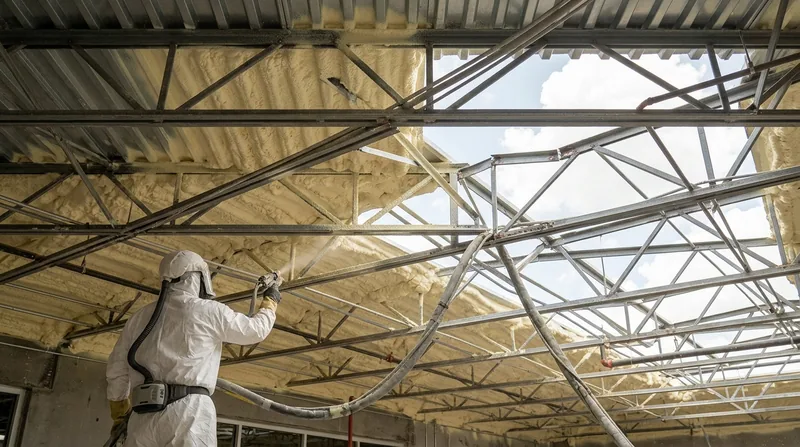




Commercial and new construction spray foam insulation in Cape Coral protects the envelope of buildings from the moment they break ground. Cape Coral's commercial and residential projects sit on slab in a hot, cooling-dominated climate where humidity drives into the building cavity year-round. Ductwork, mechanical spaces, and roof decks must be sealed tight before the humid air does the work that conditioning bills will pay for later. We spray foam roof decks from the inside during new construction and seal walls in commercial shells so the mechanical systems stay ahead of the region's moisture load. The difference between a tight building envelope and a leaky one is the difference between a predictable utility bill and a slow drain.
Why Commercial and New Construction Spray Foam Matters in Cape Coral
Cape Coral commercial buildings and new homes are built on slab with vented attics or sealed roof decks, depending on the build year and code cycle. The Caloosahatchee River and the network of canals that define the city's geography mean the air itself carries moisture. Every day, the humid outside air wants to move into the cool, dry air-conditioned inside. Fiberglass batts, blown-in cellulose, and loose-fill insulation do not stop that vapor drive. Spray foam, applied during the frame stage or to a roof deck before drywall, creates an air barrier and a thermal break in one pass. The result is less ductwork leakage, lower humidity in the mechanical space, and conditioning loads that stay predictable instead of climbing with every thunderstorm.
- Spray foam seals the roof deck and stops humid air from entering the attic cavity before the drywall goes up.
- Closed cell foam on a new roof deck creates an unvented attic that does not need soffit and ridge vents and does not require the maintenance they demand.
- Walls sprayed during framing lock in the insulation value before interior finishes hide the work.
- Commercial shells benefit from foam around ductwork, electrical chases, and mechanical penetrations that fiberglass cannot seal.
- New construction spray foam is inspected as it is applied, so there is no guessing about coverage or thermal performance after the drywall closes.
The payoff is a building that stays dry, stays cool, and does not leak conditioned air through gaps and voids that conventional insulation leaves behind.
Key info: Cape Coral's building code and the Lee County building department govern attic ventilation, ignition barriers, and thermal barriers for any spray foam job. Verify with the local building department what applies at your address before scheduling. Permits are required in most cases, and the building official will inspect the foam before drywall closure.
For more detail on how sealed attics and unvented roof decks perform in this climate, see our page on attic spray foam insulation in Cape Coral.
How We Spray Foam Commercial Buildings and New Construction in Cape Coral
Commercial and new construction spray foam is a frame-stage or rough-in operation. The building is open, the roof deck or walls are exposed, and the mechanical and electrical rough-in is complete or underway. We arrive with equipment, establish mechanical ventilation if needed, and spray the foam to the specified thickness and R-value. The foam cures in place, creating a rigid, seamless thermal barrier. Once cured, the building can proceed to drywall, finish, and occupancy. The process is fast, the coverage is complete, and the result is inspectable before it is covered.
- We meet with the general contractor and the mechanical designer to understand the scope, the roof pitch, and any ductwork or equipment that needs to be sprayed around.
- We establish the target R-value and thickness with the building official and confirm the ignition barrier and thermal barrier requirements for the building code in effect.
- We set up mechanical ventilation and establish a re-entry window of twenty-four to forty-eight hours after the foam is applied.
- We spray the foam in controlled passes, holding the manufacturer ratio and drum temperature so the foam rises and cures evenly.
- We trim the foam flush with the framing or the roof deck and prepare the surface for drywall or the next trade.
The building closes on schedule, the mechanical system starts up with a tight ductwork and a dry cavity, and the conditioning load is predictable from day one.
Example: A new commercial office building in North Fort Myers with a sealed roof deck receives closed cell spray foam at R-25 before the metal deck is covered. The mechanical contractor runs the ductwork inside the sealed cavity, and the building never sees humidity in the attic or condensation on the ductwork. A similar building in Cape Harbour with a vented attic and fiberglass batts experiences ductwork sweating in summer and higher utility bills because the humid air from the vented attic surrounds the ductwork.
For more on closed cell spray foam and its R-value specifications, see our technical page.
Spray Foam Methods for Commercial and New Construction
| Approach | Description | Best for |
|---|---|---|
| Closed Cell Spray Foam on Sealed Roof Deck | High-density foam applied to the underside of the roof deck or sheathing, creating an unvented attic cavity with R-values of R-20 to R-30 per 3.5 to 5.5 inches. | New construction and retrofit where the roof deck must be sealed and humidity must be excluded from the cavity. |
| Closed Cell Foam in Wall Cavities | Foam sprayed into framed walls during new construction, filling stud cavities and sealing around electrical boxes and mechanical penetrations. | New construction commercial buildings where air sealing and thermal performance must be uniform and inspectable. |
| Open Cell Spray Foam for Sound Attenuation | Lower-density foam applied to walls or roof decks where sound dampening is a priority and the cavity can tolerate vapor permeability. | Commercial office buildings, retail spaces, and recording studios where acoustic performance matters as much as thermal performance. |
| Foam Around Mechanical and Electrical Rough-In | Targeted spray foam sealing around ductwork, electrical chases, and plumbing penetrations to prevent air leakage in the mechanical space. | Any new construction or retrofit where ductwork and equipment must be isolated from humid or unconditioned cavities. |
Commercial and New Construction Spray Foam Cost in Cape Coral: What to Expect
Commercial and new construction spray foam is priced by the board foot, measured on site at the thickness and coverage specified in the design. The cost depends on the area to be sprayed, the R-value target, whether the foam is applied to a roof deck, walls, or both, and the complexity of the work. A sealed roof deck on a small commercial building in Cape Coral typically starts at a free commercial estimate to understand the scope. Larger projects, multi-story buildings, or buildings with complex mechanical layouts require an on-site measure and a detailed proposal. The general contractor and the mechanical designer should be involved in the estimate so the foam specification aligns with the building performance goals.
- Roof deck spray foam is measured in square feet and thickness, with the cost driven by the area and the R-value target.
- Wall cavity foam is measured by the board foot of cavity space, with the cost rising if the walls are tall, complex, or have many penetrations.
- Mechanical and electrical sealing around ductwork and chases is often priced as an add-on to the main roof or wall scope.
- Travel and setup are included in the estimate for jobs in Cape Coral and the surrounding service area.
The best practice is to get a free commercial estimate early in the design phase so the foam specification and cost are locked in before the general contractor bids the project. We provide written estimates with R-value and thickness specifications, so you know exactly what you are buying.
What to Look for When Hiring a Commercial Spray Foam Contractor Near Cape Coral
Commercial spray foam is applied during the frame stage or rough-in, so the contractor must understand building codes, mechanical design, and the role of the foam in the overall building envelope. When you are evaluating spray foam contractors near Cape Coral, look for a contractor who can walk the job with the general contractor and the mechanical designer, who understands the local building code and permitting, and who provides a written estimate with R-value and thickness specifications. Ask for references from other commercial projects or new construction jobs in the area. Verify that the contractor is fully insured and that the insurance covers the scope of work you are planning. Do not accept a bid that promises immediate re-entry, that specifies no R-value or thickness, or that is far below market price with no inspection plan. The cheapest estimate is often the one that cuts corners on ventilation, drum temperature, or application technique, and the result is a foam job that smells, does not cure properly, or does not deliver the R-value promised.
- Ask the contractor to walk the job with the general contractor and confirm the scope, the R-value target, and the building code requirements before an estimate is given.
- Request a written estimate that includes the R-value, the thickness, the board footage, and the ignition and thermal barrier requirements for your building code.
- Verify that the contractor is fully insured and that the insurance covers spray foam application and the specific scope of your project.
- Ask for references from other commercial or new construction projects in Cape Coral, Fort Myers, or the surrounding area.
- Confirm the re-entry window and the cure time with the contractor and the building official so the drywall and finish schedule stays on track.
Call us at (239) 360-6374 to schedule a free commercial estimate and to walk the job with your general contractor and mechanical designer.
Commercial & New Construction Spray Foam in Cape Coral: Pricing Guide
| Service | Price | Details |
|---|---|---|
| Free commercial estimate | $0 | On-site measure with GC and mechanical designer, written R-value and thickness specs included, no obligation to book |
| Sealed roof deck spray foam | Starting at $1.50 per board foot | Closed cell foam at R-20 to R-30 per specifications, includes mechanical ventilation and twenty-four to forty-eight hour cure window |
| Wall cavity spray foam, new construction | Starting at $1.25 per board foot | Closed cell or open cell foam in framed walls, measured by cavity volume, includes sealing around electrical and mechanical penetrations |
| Mechanical and electrical sealing add-on | On estimate | Targeted foam around ductwork, chases, and penetrations; priced separately after roof or wall scope is determined |
| Travel and setup | Included | No separate mileage fee or travel charge for jobs in Cape Coral, Fort Myers, North Fort Myers, and surrounding service areas |
| Estimate response time | Free | Free estimate within twenty-four hours of your call to (239) 360-6374, scheduled with your general contractor and mechanical team |
Indicative pricing, the exact cost depends on square footage, finish, and site access. Free personalized estimate within 24h at (239) 360-6374.


